
Posts by NRISG
NRI Manila Outlook Report 2026: Economic Resilience and Sustainability
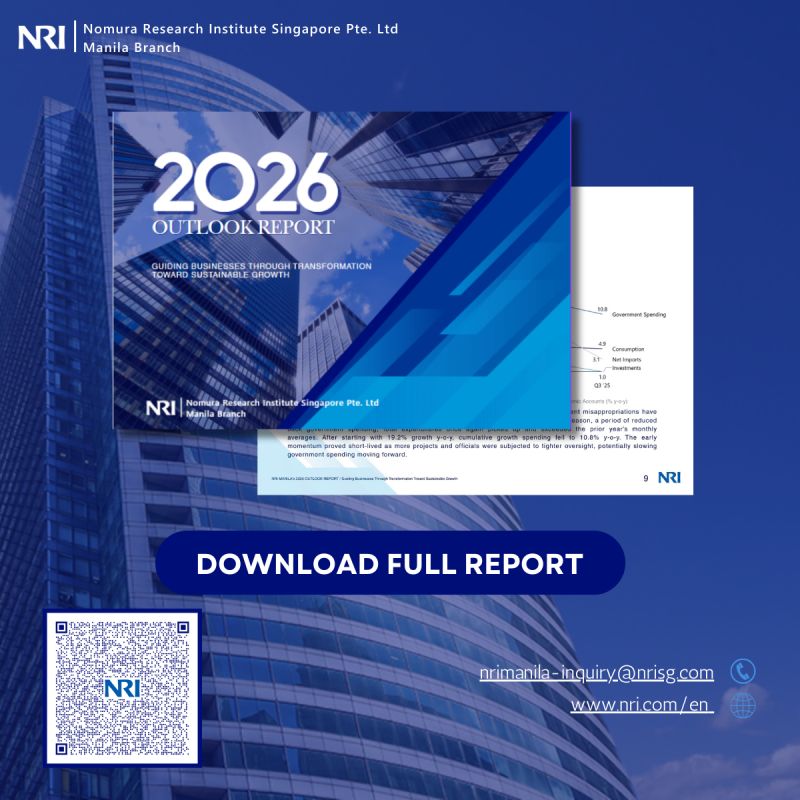
The 2026 𝐍𝐑𝐈 𝐌𝐚𝐧𝐢𝐥𝐚 𝐎𝐮𝐭𝐥𝐨𝐨𝐤 𝐑𝐞𝐩𝐨𝐫𝐭 is now live—bringing together forward-looking perspectives from NRI experts across industries to help leaders navigate what lies ahead for the Philippines. As the country enters 2026, the economy stands at a critical juncture. Growth softened in 2025 amid global headwinds and domestic challenges, even (more…)
Read MorePart 2: The Structure of the FMCG Market
In the previous article, “An Overview of the Philippine Consumer Market,” we highlighted the expansion of the middle class and explained that consumption growth is not only quantitative but also qualitative—reflecting changes in where and how consumers make purchases. In this second installment, we focus on the fast-moving consumer goods (more…)
Read MoreEmotional Regulation: The Quiet Capability Defining Tomorrow’s Leaders

They say it’s not what you know, but who you know. Increasingly, however, who you know may no longer be enough— at the end, it’s who you are as a leader. In moments of pressure, uncertainty, and conflict, how you carry yourself speaks louder than any credential or connection. People may (more…)
Read MoreTax Audit Reforms to Ease Doing Business in the Philippines
Taxes have always been an important consideration for businesses intending to invest in a market and for businesses already operating in the market. The Philippine government recognizes this and has recently been working on reforms in the tax audit system to regain public trust and investor confidence. Last November 2025, (more…)
Read MoreAre Filipinos Truly Going Cashless?

Along with traditional business disruptions and rise of eCommerce demand, the pandemic also affected the use of traditional cash as opportunities and incentives to withdraw cash were reduced due to lockdowns. This led to a noticeable slowdown in the growth of cash withdrawals, and in some periods, even a temporary (more…)
Read MoreMaking Way for the New Sustainability Disclosure Requirements in the Philippines: Adapting to Achieve Creating Shared Stakeholder Value
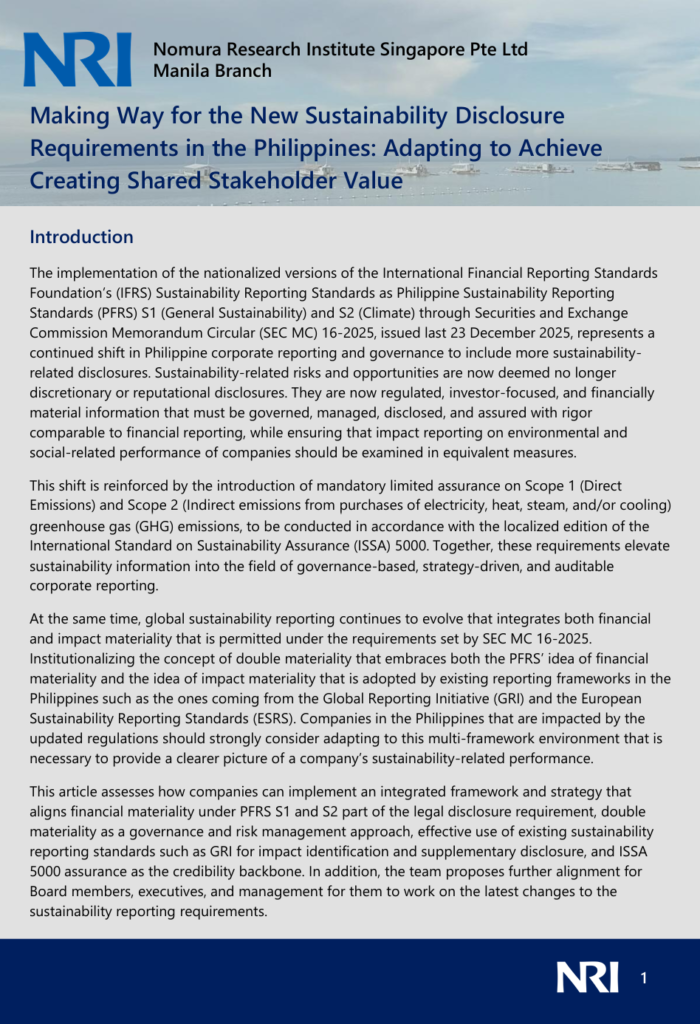
Philippine companies, sustainability reporting just got real. With SEC MC 16-2025, sustainability disclosures are no longer optional—they’re financially material, regulated, and auditable. From Scope 1 & 2 emissions assurance to adopting a multi-framework approach under double materiality, the new PFRS S1 & S2 standards are redefining corporate transparency and stakeholder (more…)
Read MorePart 1: An Overview of the Philippine Consumer Market
Source: International Monetary Fund (IMF) One useful lens for understanding the Philippine consumer market is the evolution of income levels. In recent years, GDP per capita has been on a steady upward trajectory, reaching approximately PHP 196k (about USD 3,400) in 2024. Assuming the current pace of economic growth is (more…)
Read MoreMining for a Sustainable Future: Why the Philippine Mining Sector Must Measure, Track, and Reduce Carbon Emissions
Mining and its Key Role in Decarbonization The world continues to move towards decarbonization, and many stakeholders see the mining sector as an important sector to tackle the challenges of not just addressing the issues but also taking an active role in the conversation and figuring out low-carbon solutions that (more…)
Read MoreLeveraging Carbon Credit Systems to Enhance Farmers
Introduction Climate change and rural poverty are intertwined challenges that often exacerbate the other. Hazards related to climate change disproportionately affect rural livelihoods by reducing suitable growing areas of key crops and decreasing crop yields. This causes the agricultural sector is more likely to employ less sustainable practices to keep (more…)
Read MoreAccelerating Adoption: Trends and Shifting Market Dynamics of the Philippine 4-Wheeler Electric Vehicle Industry

There is no doubt that Electric vehicle (EV) adoption has been accelerating worldwide, driven by advancements in technology, competitive pricing, and favorable policies (1). While this growth has been most pronounced in advanced economies, ASEAN markets have been quickly catching up over the past few years. The Philippines, despite historically being (more…)
Read More